
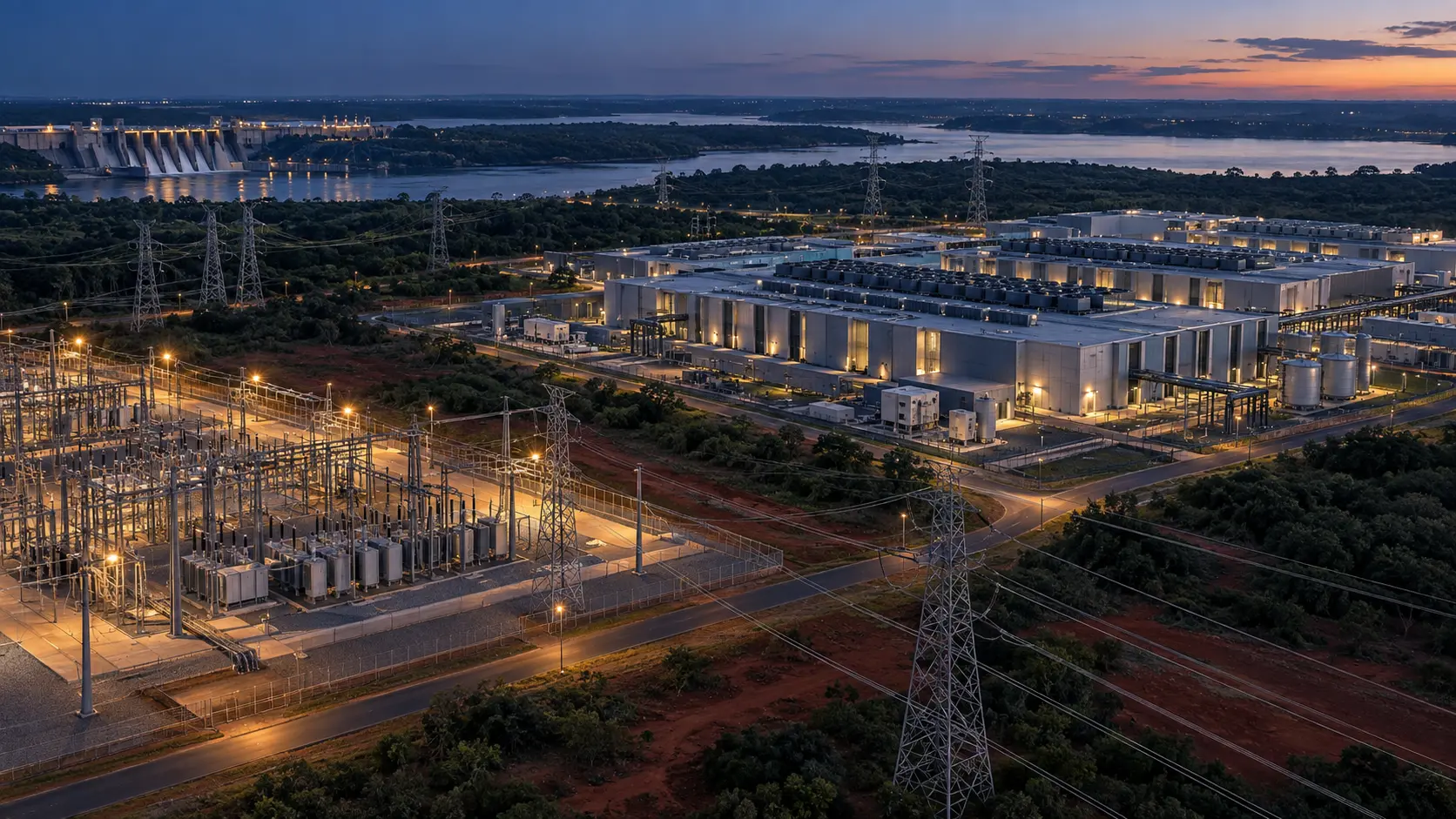
Paraguay is negotiating the arrival of data centers and artificial-intelligence loads at a scale that would have seemed improbable only a few years ago. The usual question is how much surplus hydropower can be sold to them. That is incomplete. The strategic question is what new energy capacity must be left behind by anyone seeking to use, at scale and for decades, the resource that made its arrival possible.
A hyperscale data center can mobilise billions of dollars, yet its permanent employment and local supply-chain effects are limited relative to the power it requires. Energy should therefore not be treated merely as a low-cost input for attracting investment. It must form part of the consideration received by the country.
Paraguay should consider a clear rule: every new system-scale electro-intensive load must include a substantial share of the additional firm capacity it needs in its financial structure, pay for attributable grid reinforcements and deliver auditable stability performance. Whenever the project has unused capacity, a contracted portion should be available to ANDE under a regulated formula.
Annual energy is not available power
Paraguay retains an exceptional energy position, but not an infinite surplus. Electricity consumption rose 12.5% in 2025. On 26 January 2026 the National Interconnected System reached a record 5,752 MW. Institutional forecasts place full use of available hydropower in the early years of the next decade, with different dates depending on whether the calculation concerns annual energy, firm power, hydrology or transmission capacity.
ANDE has also reported expressions of interest from prospective electro-intensive consumers totalling approximately 6,300 MW. They are not contracts, approved requests or simultaneous loads. They nevertheless show that potential interest is already comparable with the country’s entire current peak demand.
Power comparison, not a claim of simultaneity. The 6,300 MW represent potential interest; ATOME’s 145 MW correspond to a future project. These figures must not be mechanically added to current demand.
The resource exists once. It cannot simultaneously be sold as exportable surplus, reserved for new industry, promised to data centers and retained as a security margin for domestic growth.
ATOME: a useful precedent, not a culprit
ATOME’s green-fertiliser project in Villeta makes the issue concrete. The company states that it has secured a long-term supply of 145 MW of baseload hydropower for a plant expected to operate in 2028. That is approximately 2.5% of today’s national peak. On its own it does not collapse the system, and portraying it as responsible for a crisis that has not occurred would be wrong.
ATOME is also not equivalent to a data center. It converts electricity into fertiliser, adds an industrial chain and may reduce regional imports. The case matters for a different reason: a block of power committed for years is no longer available to other uses over the same contractual horizon.
The issue emerges through accumulation. Villeta’s 145 MW sits beside a second 300 MW phase still at pre-agreement stage, other industrial projects and data-center proposals that may individually be several times larger. System security is not lost through one contract; it is eroded when every negotiation is assessed as if it were the only one.
The cost of writing the rule afterwards
The case ceased to be only an energy matter on 17 September 2026. ATOME served Paraguay with a notice of dispute and intention to submit a claim to international arbitration after the Executive repealed the Energy-to-X regime that had supported certainty over the term and price of supply. The notice does not yet formally commence arbitration: it opens a three-month consultation period under the United Kingdom–Paraguay bilateral investment treaty.
The figures must be kept separate. The 145 MW refer to the expected Villeta supply. The USD 665 million figure refers to the announced value of the project, not to an amount of energy. Any eventual claim will depend on what is ultimately pleaded and proven.
The dispute exposes two state obligations that should not be confused. Government must prevent a rigid long-term tariff from undermining ANDE or transferring risk to ordinary users. It must also preserve legal certainty for investors that structured financing around express state acts. Creating special terms by decree and withdrawing them after an investment decision can turn poor energy planning into an arbitration contingency.
The answer is not to promise faster and repeal later. It is to establish, before contracting, a general, published and technically costed rule for everyone: incremental capacity, formula-based tariff review, investment milestones, guarantees, adjustment triggers and an explicit allocation of risk.
Paraguay therefore needs a consolidated register of measured, contracted, reserved, requested and probable power, including entry dates and simultaneity factors. Without it, an apparently manageable project portfolio can become a physical obligation that generation, transmission or both cannot meet without degrading service to homes, hospitals, irrigation and domestic industry.
Extrapolating the precedent to a hyperscale data center
The parallel with a future hyperscale computing campus is direct, even though the economic activity is different. A 500 MW campus would equal 3.4 times Villeta’s power and roughly 8.7% of the current national record. A 1,000 MW campus would be 6.9 times Villeta and approximately 17.4% of the same peak.
Percentages use the 5,752 MW demand record. The 500 and 1,000 MW scenarios illustrate scale; they do not describe a contracted project.
These relationships do not prove that Paraguay lacks the capacity to host such facilities. They prove that a commitment of this size cannot be treated as an isolated commercial sale. If government guarantees price, firmness and an energisation date without securing incremental capacity, the system and the public absorb the operating risk. If those guarantees are later reversed after financing has been structured, the State and taxpayers absorb the legal risk.
This matters especially within a government policy designed to attract technology investment. The risk need not arise from one exceptional project; it may arise from the cumulative success of the promotion policy itself. The existing power system can integrate certain individual loads, but it cannot by itself guarantee a multi-gigawatt portfolio simultaneously and on a firm basis without new generation, transmission and stability services. Each memorandum may look manageable in isolation while the portfolio exceeds the physical capacity that all parties assume is available.
Announcements, reservations and applications must therefore be managed as one national energy portfolio. Approval cannot depend only on the attractiveness of an investment; it must be subordinated to aggregate capacity limits, expansion milestones and technically verified connection dates.
The right framework must avoid both extremes: no definitive reservation before an integrated system study; no financial close without supporting generation and transmission; and no full connection before the committed assets have actually entered service.
A load that also raises stability issues
Large computational facilities do not always behave electrically like conventional factories. In 2025 NERC documented sub-second transitions in a 50 MW block inside a 200 MW AI-training facility. It also recorded aggregate load-reduction events close to 1,500 MW involving voltage-sensitive large loads, with frequency and voltage effects.
This does not mean an entire one-gigawatt campus switches at once. It means blocks inside it can vary fast enough to require modelling, telemetry, ramp limits, protection coordination and reserves.
The right requirement is therefore not a prescribed machine. It is a set of performance obligations: dedicated firm power, frequency response, voltage and reactive-power regulation, disturbance ride-through, power quality, N-1 redundancy, real-time observability and, where the grid study requires it, synchronous inertia or a technically equivalent response.
SMRs: firm, low-carbon energy and inertia for the pool
Within an open technology portfolio, a small modular reactor, or SMR, may be an option for large continuous loads. It should not be imposed as the sole solution or contracted before completing nuclear-safety, siting, water, grid, fuel, waste, safeguards and licensing studies. Yet an SMR delivering electricity through a turbine and synchronous generator can provide firm power, low-carbon energy, voltage support and physical inertia at the same time.
Energy not consumed by the project can enter ANDE’s generation pool and benefit all users instead of remaining behind a data center’s meter. It should be marketed as “green” only if Paraguay’s future taxonomy recognises nuclear generation within that category; until then, the technically precise description is low-carbon energy.
The decisive mechanism is the tariff. ANDE’s purchase price for SMR surplus should be capped by the Itaipú or Yacyretá benchmark defined in the contract. If the SMR’s full cost is higher, the developer and the project’s economics bear the difference—not the regulated consumer. There should also be no take-or-pay clause, sovereign guarantee or automatic cost-overrun recognition that passes construction, financing, fuel, waste or decommissioning risk into the retail tariff.
Private capital
The project bears construction, financing, fuel, security, waste and decommissioning costs.
Price ceiling
ANDE buys surplus under an agreed maximum formula without recognising developer overruns.
National pool
Firm low-carbon energy and verified grid services enter the power system.
Protected consumer
There is no automatic pass-through of SMR costs to the retail tariff; the intended effect is neutral or downward.
Competitiveness does not come from the technology label. It comes from allocating risk correctly and contractually limiting the price paid by ANDE.
With that allocation, the SMR does not automatically raise ANDE’s retail tariff: it adds firm energy at the agreed ceiling and physical stability to the system. The effect on the pool’s average cost can be neutral or favourable, helping preserve highly competitive prices for households, services and industry. That outcome is not inherent to the technology; it must be demonstrated through the financial model, grid study and an independent tariff test before signature.
Bring the energy with you
In the conventional model, a project consumes existing capacity and the system later invests to rebuild the lost margin. Under the proposed model, a relevant share of that expansion forms part of the capital expenditure of the party creating the new demand.
New demand
The project discloses load, ramps and its realistic energisation date.
Incremental capacity
It funds or contracts firm generation and attributable network upgrades.
Verifiable stability
It meets frequency, voltage, reactive power, ride-through and ramp limits.
System value
ANDE receives surplus at the agreed binational cost.
The public system preserves the margin needed for homes, industry, irrigation, health services and future growth.
Public facilitation in exchange for energy and infrastructure
This obligation does not require government to be hostile to investment. On the contrary, Paraguay can offer a single permitting window, short and binding approval timelines, coordinated interconnection studies, fiscal and regulatory stability, orderly access to land and infrastructure, and institutional support through financial close.
Reciprocity must be written into the same contract. In exchange for those facilities, a mass-consumption project assumes the incremental energy capacity enabling its operation as a binding obligation: through self-generation or contractually dedicated generation, commissioned in stages and backed by enforceable security. Each load block is energised only when the corresponding generation block and transmission upgrades are in service.
The contribution does not end with generation. It must include the infrastructure required to integrate that supply and turn it into useful national capacity: lines, substation bays, transformation, reactive compensation, storage or backup, protection, telemetry and redundancy. The contract should separate project-attributable works—which the project funds—from network-wide upgrades that may be co-financed, and define ownership, maintenance, ANDE usage rights and the final disposition of assets when the concession or supply term ends.
This does not prescribe one technology or require total isolation from the grid. It prevents the public incentive from becoming, in practice, a transfer of existing firm capacity whose replacement cost is borne by the rest of the country. Government facilitation accelerates the project; the energy contribution protects the system.
Dedicated generation need not isolate the project. A properly engineered interconnection can benefit both sides. The contract should specify how much capacity ANDE may call, for how long, with what notice and availability, and how energy, capacity and ancillary services are remunerated separately.
The proposed economic condition should be explicit: committed surplus energy is sold to ANDE at the current, verifiable production cost of Itaipú or Yacyretá, using the benchmark defined in the contract. It is not sold at an international price or with a scarcity premium. This delivery forms part of the consideration for public facilitation, not a second energy business for the large consumer.
For the clause to be enforceable, it must distinguish genuinely available surplus from exceptional dispatch. If ANDE requests additional production that requires fuel consumption or creates a higher marginal cost, the difference must follow a predefined formula. Surplus energy retains the binational benchmark; capacity and ancillary services are remunerated separately only when government requires performance beyond the project’s basic obligation.
The intended economic effect goes beyond grid protection. The large consumer finances new capacity and infrastructure, while ANDE incorporates the surplus at a low generation benchmark. This expands the competitive supply available to industry, manufacturing and services, contains the system’s average supply cost and prevents Paraguay’s energy advantage from being captured by a small number of enclave projects.
The final tariff will still include transmission, distribution, losses and system investment, so it will not equal the binational generation cost. Yet an expanded supply base at that cost helps preserve low, predictable energy prices for diversified productive investment that creates supplier chains, employment and lasting industrial capacity.
The rule must precede the contract
Law 7599/2025 opened space for private generation, self-generation and commercialisation from certain non-hydropower renewable sources. It is progress, but not a comprehensive large-load connection policy. That policy must address technology, transmission, financial guarantees, operational information and liability for non-performance.
Seven minimum conditions
- Incremental capacity: firm generation or dedicated contracts that do not rely entirely on the existing margin.
- Independent study: generation, transmission, voltage, frequency, harmonics, water and contingency impacts.
- Staged connection: authorised power grows only when the assets supporting it enter service.
- Enforceable security: guarantees, milestones and penalties so promised expansion is more than a declaration.
- Telemetry and control: real-time observability and coordinated load-reduction protocols.
- System value: capacity, surplus or ancillary services available to ANDE under a prior contract.
- Aggregate transparency: periodic publication of measured, committed, reserved and probable power without disclosing trade secrets.
Protect the country’s development capacity first
Data centers can bring investment, digital infrastructure, specialised demand and technological capability. Electro-intensive industries can create products, exports and local value chains. None of those opportunities justifies committing the same power twice or transferring to the general consumer the cost and risk of rebuilding the margin used by a private project.
The priority is not to close the door. It is to change the entry condition. Paraguay can host large consumers without turning its hydropower advantage into a constraint on its own population.
The right question is not how much capital a facility announces or how much energy it can buy today. It is what new capacity, verifiable stability and additional margin it leaves installed after using the resource that enabled its arrival.
That is bringing the energy with you.
Sources and reading criteria
- ANDE: Paraguay’s 2025 electricity consumption.
- ANDE: January 2026 peak demand.
- NERC: Characteristics and Risks of Emerging Large Loads.
- ATOME: 145 MW Villeta project.
- ATOME notice of dispute and intention to arbitrate.
- ARRN: pressure on the power mix and diversification.
- Electro-intensive expressions of interest reported by ANDE.
- Law 7599/2025 on non-hydropower renewable generation.
- International Energy Agency: Energy and AI.
- IAEA: nuclear generation, low-carbon energy and grid inertia.
The figures distinguish measured demand, secured supply and expressions of interest. ATOME’s notice does not yet constitute the formal commencement of arbitration. The proposed contractual rule and the conclusions are the author’s. Whether nuclear electricity is legally labelled “green” depends on Paraguay’s future taxonomy; technically it is described here as low-carbon.